Water to Work Internship does more than fill vacancies
July 10, 2026

AWWA Articles
Water to Work Internship does more than fill vacancies
What if workforce development focused less on filling specific vacancies and more on helping people find their place in the water sector? That question is at the heart of an internship program in Grand Rapids, Michigan, that is built for exploration, mentorship, and long-term career growth.
Interns rotate through drinking water and wastewater operations, maintenance, and other functions, gaining exposure to the breadth of careers available across the water sector. Rather than a prescribed pathway, the program is designed as a personalized, “choose-your-own-adventure,” said Hillary Caron, who launched and led the program from 2022 to 2025. Caron is now director of education and workforce training at the Michigan Section of AWWA.
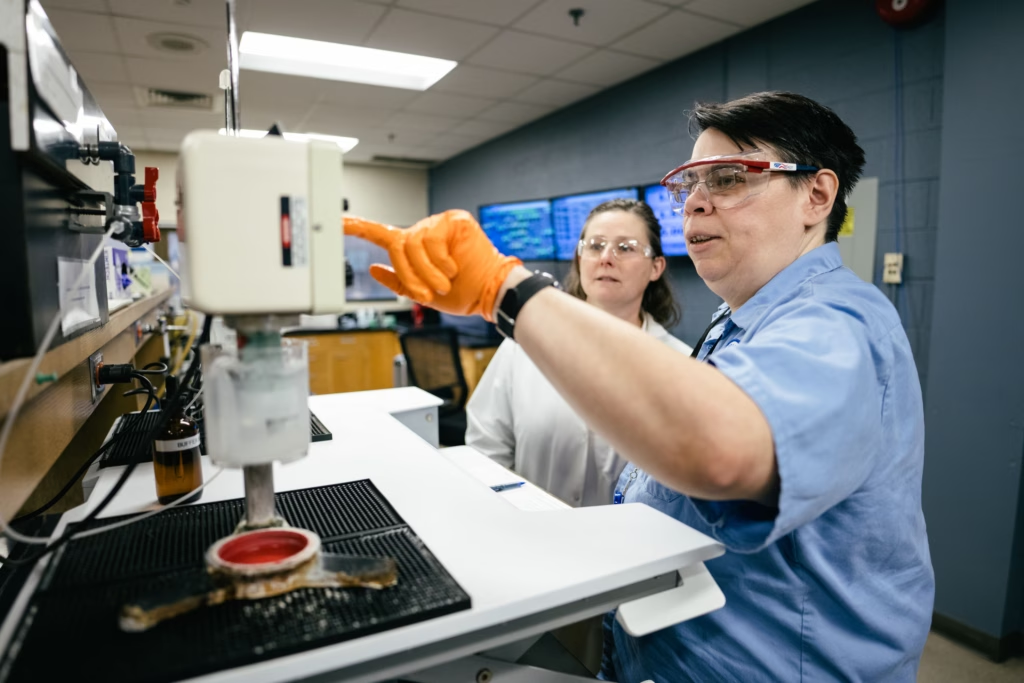
“One of the first things interns do is identify what their core values are,” Caron said. “Then, with the guidance of mentors and program leads, we can say, ‘Here’s a space within the water sector where you may find fulfillment based on your values.’ There are a lot of different entry points within the water world; it’s not a linear pathway, and we act as the guide.’
The Water to Work Internship is a 52-week program from Grand Rapids Community College and Bay College; it is supported by an Innovative Water Infrastructure Workforce Development Grant from the U.S. Environmental Protection Agency. The program started in 2022 through a partnership with the city of Grand Rapids; and it is expanding this year to include three additional municipalities: Plainfield Charter Township, the city of Wyoming, and the Holland Board of Public Works.
“Most of these municipalities have hired graduates from our program before, so they have seen the benefits,” said Haley Kozal, who now oversees the internship as program manager at Grand Rapids Community College. “They know that our students are hard workers, and they’re willing to invest and take the time to train the next generation.”
Interns are enrolled in small cohorts of six to eight, and they work part-time (24 hours per week) at a drinking water or wastewater facility while simultaneously working toward a Water Technology Certificate through Bay College’s online coursework.
“One of the core tenets of this program is the cohort model so the students can rely on each other and go through the same types of experiences,” Kozal said, noting that while the students are spread across facilities, they have field trips and professional development opportunities that bring them together regularly.
That philosophy is reinforced through structured mentorship, which is another critical piece of the program. Interns select their own mentors from a pool of water professionals curated by program leads. Mentors introduce interns to colleagues, share job leads, and help them understand the many opportunities in the water profession.
Equally important are the program’s wraparound supports. The EPA grant covers tuition and books, which means the educational component is free for interns, and municipalities provide part-time wages for interns who are working at one of four partner utilities.
Additionally, Grand Rapids Community College provides workforce support, like resume reviews and mock interviews, and transportation assistance like gas cards. Drinking water and wastewater plants can sometimes be lengthy commutes for interns. Each partner ensures the program is equitable and effective, Caron said.
“We hope that students not only find a career pathway that’s a good fit for them — one that they feel confident in and that they chose — but we also hope that this helps them find economic mobility,” Kozal said.
Because of that intentional design — and the program’s small cohort model — outcomes are strong. Every participant who has completed the program since its inception in 2022 has secured employment in the water sector, often before the internship ended — and they all continue to work in the sector. Some have achieved promotions as well.
Graduates go on to roles as operators, mechanics, lab technicians, engineers, and contract professionals, working at utilities and organizations across Michigan and even neighboring states.
“We’re sending students into this industry who really have a passion for it and aren’t doing it to do it because it’s a job,” Kozal said. “These people are really invested in protecting our public health.”
Advertisement