Philadelphia’s award-winning approach to protecting drinking water
August 21, 2026

AWWA Articles
Philadelphia’s award-winning approach to protecting drinking water
Much of the water that eventually reaches Philadelphia residents’ taps travels through a watershed stretching more than 100 miles upstream, making cooperation beyond city limits a key component of drinking water quality.
“Creating strong partnerships with our upstream neighbors is critical to Philadelphia’s source water protection,” said Matthew Fritch, watershed protection program manager at the Philadelphia Water Department.
About 60% of the city’s drinking water comes from the Delaware River, and the Schuylkill River supplies the remaining 40%. The city makes up less than 2% of the watershed area upstream of its drinking water intakes.
“Philadelphia has a long history of source water protection, with the city establishing Fairmount Park in the 19th century to act as a natural buffer for the Schuylkill River,” Fritch said.
“While it’s not as easy to set aside undeveloped land today, we still look upstream for ways to protect our source water,” he added.
Philadelphia’s efforts were celebrated this year when the department received the 2026 AWWA Exemplary Source Water Protection Award for its program built on regional partnerships, upstream investment, long-term monitoring, and emergency preparedness.
The water department formalized much of its regional work in 2003 when it created the Schuylkill Action Network with support from the U.S. Environmental Protection Agency and Pennsylvania Department of Environmental Protection.
“It grew out of a source water assessment that made a clear connection between Philadelphia’s water quality and upstream conditions,” Fritch said. Today, the network includes more than 300 watershed organizations, conservation groups, businesses, academics, water suppliers, recreational groups and government agencies.
“What makes the [Schuylkill Action Network] successful are perseverance — decades-long collaborations and building trust between partners — and real investment that puts dollars toward programs and projects,” he said.
One example is Northwestern Stables near Wissahickon Creek, which connects to the Schuylkill. The water department helped support improvements designed to keep manure and stormwater runoff from reaching the creek, including drainage and paddock improvements and 12,000 square feet of vegetated buffer.
“The project was completed in 2020 and offered a unique chance to manage pathogens, sediment, and nutrients on an in-city property,” Fritch said.
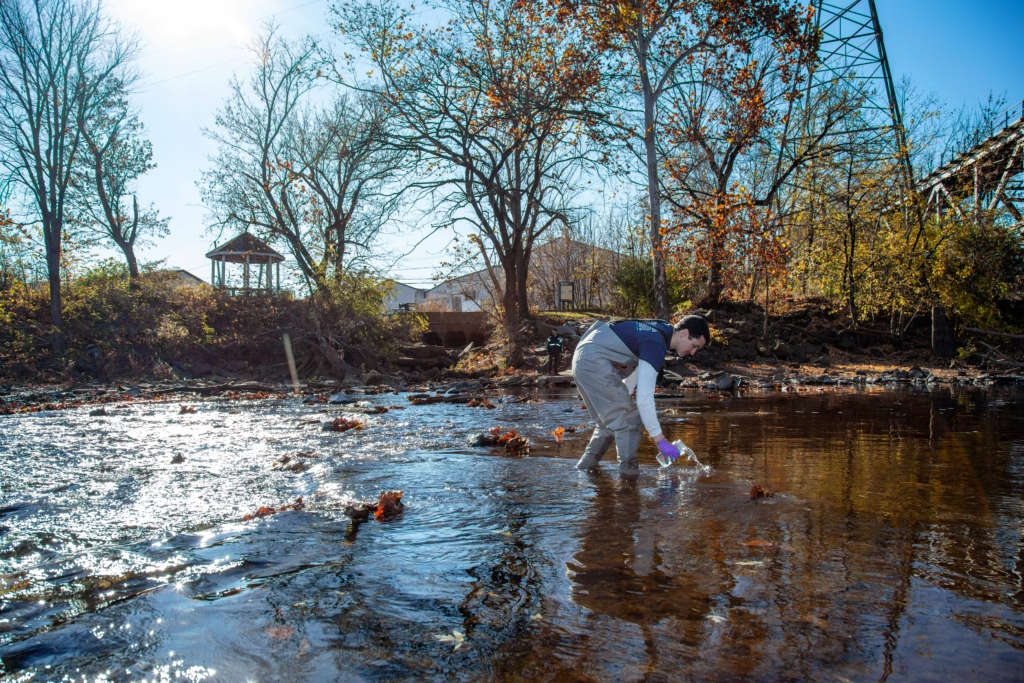
The water department also depends on monitoring to help the utility react quickly while planning for the long term. In-stream stations track trends in water quality and quantity that inform treatment and infrastructure decisions decades into the future. For immediate threats, the Delaware Valley Early Warning System alerts drinking water suppliers to spills and contamination events and uses a time-of-travel model to estimate when they could reach downstream water intakes.
“The [early warning system] is one of our greatest achievements in terms of fostering regional collaboration among water utilities, federal and state agencies, emergency responders, and industrial water users,” Fritch said.
The program continues to evolve as new challenges emerge. Water department leaders are monitoring PFAS occurrence and trends and assessing treatment needs, while also considering how growing data center development could affect future demand and system capacity.
But Fritch said sustaining the program ultimately depends on the same principle that has shaped it for years: “We’re all in this together.”
That includes the public. Every year for about 15 years, Philadelphians have selected a “spokesdog” to encourage residents to pick up pet waste before it can wash into rivers and streams. The 2026 Spokesdog, Gracie Girl, will carry that clean-water message at community events throughout the year.
For Source Water Protection Week, Sept. 27-Oct. 3, AWWA invites utilities and communities to participate by highlighting where drinking water comes from and the people and partnerships working to protect it.
Advertisement