Los Angeles creates a model for large-scale water reuse
May 29, 2026

AWWA Articles
Los Angeles creates a model for large-scale water reuse
Los Angeles imports about 90% of its drinking water.
This puts the city in an increasingly precarious place as the region contends with longer bouts of drought and other climate extremes.
“For us, importing water at that scale is just not sustainable anymore,” said Anselmo Collins, chief operating officer and senior assistant general manager at the Los Angeles Department of Water and Power (LADWP). “We have to find new, innovative ways to provide safe, reliable water locally — and recycled water is a big part of that solution.”
The Los Angeles Groundwater Replenishment Project — currently about halfway through construction — will take treated wastewater and put it through advanced treatment, including microfiltration, reverse osmosis, and ultraviolet advanced oxidation. The purified water will be routed to the San Fernando Groundwater Basin — replenishing the aquifer, reducing the city’s reliance on imported water, and ultimately protecting the region against drought.
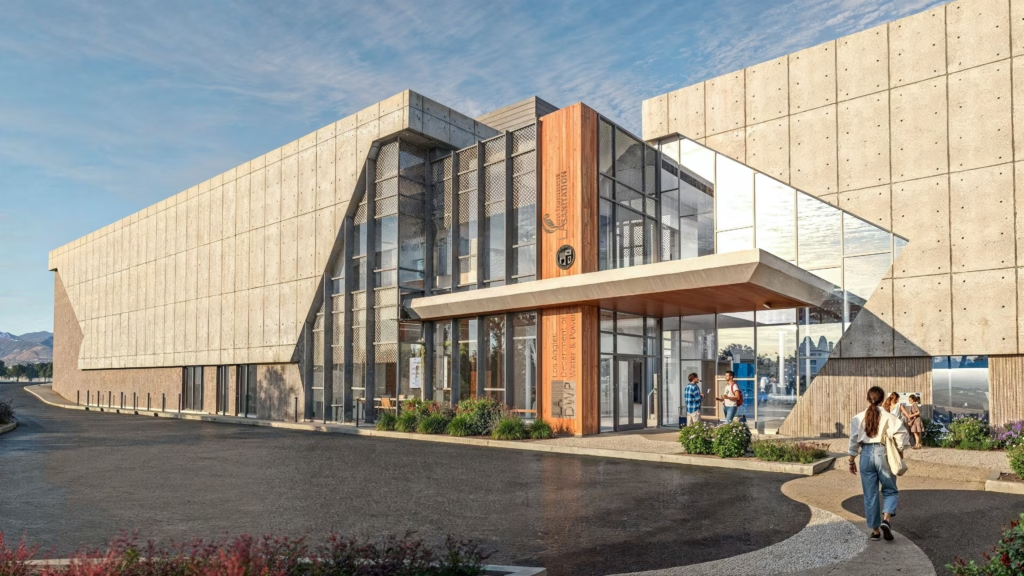
The project has received national attention because of its size and scale, and the city hopes it will be a model for others to follow.
LADWP, in partnership with LA Sanitation, is leading the $1 billion project — which, upon its completion, will supply 45 million gallons of water per day (enough to supply 500,000 residents).
It is currently the largest active water project in the state. Picture the size of a Costco warehouse and stack it three times — and that’s just the advanced water purification facility. Also included on site are equalization tanks (each is the width of a professional football field), a new administrative facility for maintaining operations, and additional improvements to protect the environment and provide public access.
“This is a flagship facility for LA,” said Jesus Gonzalez, who oversees the project and recycled water programs at LADWP. “We are reimagining this wastewater plant by utilizing advanced treatment to produce drinking water. We’re showcasing how to utilize water reuse to develop a new water supply, and we want to encourage others to also utilize LA’s lessons to advance the developments of their own projects.”
Included in the three-story facility is an extensive, museum-like education center that will be open to the public and designed for informational tours relevant for groups from school-age to Ph.Ds. Visitors will be able to learn about LA’s history and future water supplies, in addition to the water cycle and advanced treatment. The treatment facility will be visible from platforms around the facility, encouraging transparency in reuse and its reliability to protect public health.
“We want people to see there’s nothing secret or scary about this,” Gonzalez said. “This is some of the most advanced water treatment technology in the world. [The Groundwater Replenishment Project] will produce some of the highest quality water in the state, and it will also protect public health for future generations.”
Advanced purification — or the idea of recycling wastewater for drinking water — is not new, but the scale and speed of the project has grabbed the attention of many in the industry. Construction began in December 2024 and completion is scheduled for the end of 2027 — just ahead of the 2028 Olympic Games, which will be hosted across the street.
“We’re nearly halfway through construction. That pace is what’s really taking the industry by storm,” said Gonzalez, who had recently finished hosting a delegation from Germany that came to see the progress for themselves.
He credits a strong collaboration across agencies for the progress they’ve seen thus far.
“This project would not be possible by a single agency alone,” he said. “It shows what’s possible when people have a shared vision and focus on doing what’s best for the community.”
The collaboration has also helped unlock significant funding. Of the project’s $1 billion price tag, $428 million has come from external sources, including local, state, and federal entities — the most amount of funding, proportionally, that LADWP has received for a single project.
Gonzalez said the project benefits more than Los Angelenos; replenishment projects like this one have applications in other regions across the world. He sees the investments in this one as hope for more projects like it.
“This is a framework for other cities, states, and countries. We’ve given the model of how to do it at scale and how to do it very fast and efficiently,” he said. “There’s no secret sauce. It’s leadership, collaboration, and people who want to do something big and important. If we can do this in Los Angeles, we know that others can have the confidence to do it also.”
Advertisement