Keep Funds Flowing: SRFs help Missoula tackle a century old leakage problem
March 31, 2026

AWWA Articles
Keep Funds Flowing: SRFs help Missoula tackle a century old leakage problem
When Missoula, Montana, took ownership of its water system in 2017, city leaders faced a challenge more than a century in the making: aging pipes that leaked more water than they delivered. A study from 1927 had already warned that leakage rates were “excessive.” One hundred years later, little had changed.
“Our leakage rate was well over 50 percent when the city took over,” said Logan McInnis, deputy director of utilities for Missoula’s public works and mobility department. “And because of our soils — sand, gravel, and cobble — leaks don’t surface. Without technology, you can’t find them.”
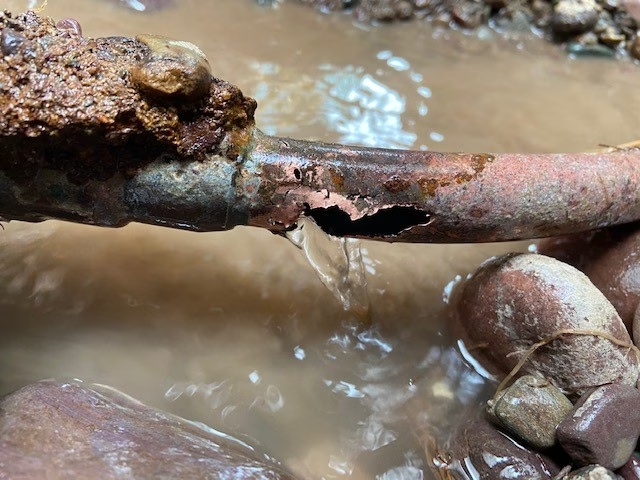
Since then, Missoula has launched an aggressive effort to track down leaks and rebuild its underground system. But the scale of the problem required resources far beyond what local ratepayers could support. That’s where federal funding made all the difference.
As a municipal utility, Missoula gained access to low-interest loans from the Drinking Water State Revolving Fund (SRF) — an option the previously private system never had.
“The private owner had to borrow at 7% or 8% interest,” McInnis said. “With SRF, our interest rate is 2.5%. That’s huge for our customers.”
SRFs provide low-cost loans for utilities to undertake critical infrastructure upgrades that might otherwise balloon budgets or place a financial burden on ratepayers. SRFs and other programs like it receive federal backing, and the American Water Works Association is elevating stories like Missoula’s to illustrate the importance of continuing funding for them.
Since 2020, Missoula has secured about $28 million in SRF loans (plus $6 million in American Rescue Plan Act grants) to replace aging water mains. The city has already rebuilt 13 miles of pipe, reducing leakage by 30 percent in just four years.
While SRF funds the pipe replacements, Missoula is also investing in targeted leak detection. The utility recently purchased acoustic data loggers — devices attached to hydrants that register the unique sound of leaks at night, when ambient noise is low. The data loggers identify leaks, and Missoula water crews perform follow-up testing with acoustic correlators and ground microphones.
“They’ve been a game changer,” McInnis said. “In just a year and a half, we found over 250 leaks. And I don’t think we’ve dug any dry holes as a result of these.”
Even with major system upgrades, Missoula has kept rate increases modest — averaging a 3.5% increase annually.
“We’ve spent more than $34 million replacing mains … but we’ve avoided rate shock as a result of the SRF program,” McInnis said.
Without SRF, Missoula would face a stark choice: delay repairs, raise rates significantly — or both.
“We feel a big part of the health and vibrancy of a community depend on the condition of its infrastructure that people rely on to get around, to protect their local water resources from pollution, and for the drinking water they need to survive,” McInnis said. “Without SRF, we would struggle to maintain that infrastructure.”
Has your utility received an SRF or WIFIA loan for an infrastructure project? If AWWA can feature your project in its advocacy efforts, please fill out this form.
Advertisement