Two careers in water, united by service
November 23, 2026

AWWA Articles
Two careers in water, united by service
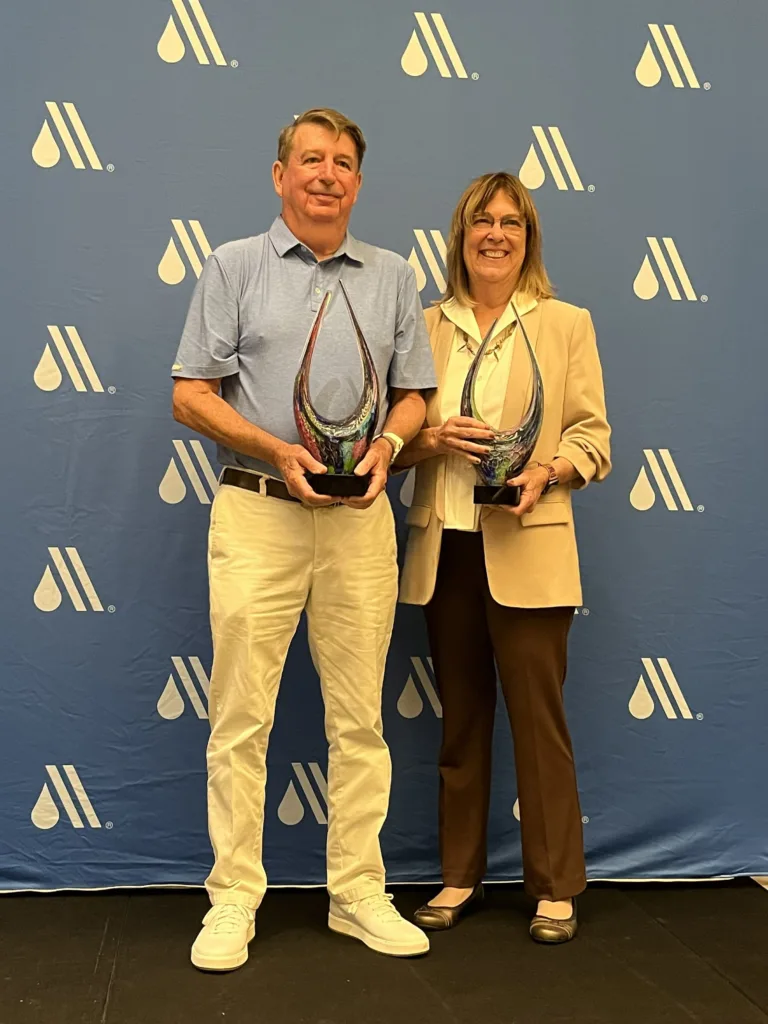
Nancy McTigue and David Cornwell have spent decades tackling water challenges, helping utilities, and volunteering their expertise to advance the profession. Now, the two AWWA Virginia Section members share another distinction: They are believed to be the first married couple to each receive the George Warren Fuller Award.
The Fuller Award recognizes distinguished service to the water supply field and is presented annually to honorees selected by AWWA Sections. McTigue received it this year; Cornwell in 2022. For McTigue, receiving it from an organization woven throughout her professional life was particularly meaningful.
“It’s a real honor to be recognized by an association that’s been such an important part of my career,” she said.
McTigue’s graduate studies at Stanford University focused on drinking water, leading to her first job with the U.S. Environmental Protection Agency, where she worked with Region 8 water utilities in support of the Safe Drinking Water Act. There, she worked for Jack Hoffbuhr, former AWWA executive director, who encouraged her to join AWWA.
The advice stuck.
“For my entire career, I have been on one committee or another,” she said, noting participation on the Technical and Education Council, research committees, an early iteration of Women in Water, and currently, the Standards Council.
McTigue’s career took her to what is now the Water Research Foundation and later Cornwell Engineering Group, where she now oversees its certified drinking water laboratory and works with municipal clients.
Some of the work she is most proud of combines another of her strengths with her technical expertise: communicating complicated water topics clearly. McTigue has contributed to AWWA publications and operator materials and points to her work on “The Water Dictionary” and “Plain Talk About Drinking Water” among her proudest accomplishments.
That emphasis on communication is something she passes along to younger professionals.
“Communicating accurate information about water quality and treatment is as important as the engineering task itself. Our customers, clients and the public rely on us for this information,” McTigue said. “Working on AWWA committees and presenting at conferences are great ways to learn these skills.”
Cornwell’s route into drinking water was also shaped by a mentor. While earning his master’s degree in environmental engineering at the University of Florida, he studied under Ed Singley, an eventual AWWA president and A.P. Black Research Award recipient. Singley encouraged him to deepen his knowledge of chemistry, chemical engineering, and corrosion, setting Cornwell on a professional course he has followed ever since. His doctoral research focused largely on the treatment and management of water-treatment plant residuals.
“I’ve liked it ever since; I wouldn’t have picked anything different,” Cornwell said.
After teaching at Michigan State University, he founded Cornwell Engineering Group and has served as its president since 1985. He also joined the University of Florida faculty, where he teaches and collaborates on research in environmental engineering.
His career has centered on solving the difficult technical problems utilities encounter, from treatment challenges and turbidity to lead and emerging contaminants.
“It’s these challenges that I like to work on,” Cornwell said, “because it’s always different and I’m always looking for new solutions for things.”
When asked what has kept him in the water industry, Cornwell mentioned something else: the people. He described a field in which professionals at competing consulting firms share knowledge when someone is trying to solve a water problem. “I feel that everyone in this field’ s main concern is the protection of public health, and they take that responsibility seriously. It’s a great group of people to work with — and that’s a lot to say about a field,” he said.
Cornwell’s AWWA service has included the Board of Directors, Executive Council, and leadership of the Technical and Educational Council. He is also a recipient of the A.P. Black Research Award, like his mentor, and he names it among his proudest accomplishments.
For both McTigue and Cornwell, AWWA involvement has been about more than technical contributions. Both describe a water community built on people helping one another and preparing the next generation to carry the work forward.
“So much of the work that AWWA does is in the informal interactions that you have in committee meetings,” McTigue said.
That is what made the Fuller Awards so meaningful, the pair said. It reflects the tradition they inherited from influential mentors and have committed to continuing through their own service and volunteer leadership.
And neither appears particularly interested in calling their work finished.
“It’s been a great career,” Cornwell said. “I’m not done yet, but it’s been a great career and I enjoy every bit of the water field.”
Advertisement