Lending industry expertise in the classroom
July 24, 2026

AWWA Articles
Lending industry expertise in the classroom
A couple years ago, the Illinois Section of AWWA (ISAWWA) received a call from a local community college interested in launching an educational program for water and wastewater technicians.
The community college had received a $350,000, three-year National Science Foundation grant to develop an initiative to address regional workforce demand.
“They already understood this was an industry in need of workers and they were asking, ‘What can we do as an educational institution to meet this new need?’” said Laura Morgan, outreach specialist at ISAWWA.
Thus began a partnership that focuses on building pathways to careers in water.
The Water and Wastewater Technology Program at Waubonsee Community College west of Chicago is in its second year. ISAWWA members teach some of the courses, host some of the interns, and otherwise help inform the curricula.
“We quickly realized that it’s really important to match what the students are learning to what the industry wants the mastery in,” said Sheela Vemu, the associate professor at Waubonsee who launched the program with fellow faculty member Nancy Christensen. They pulled together a Business and Industry Leadership Team of regional partners, including ISAWWA, to inform the program’s components.
“One of the biggest things we emphasized is how many different jobs exist,” Morgan said, referencing lab work, operations, engineering, and administration. “Understanding what happens, how decisions are made, the mechanics, and the whole part of public works and water — it’s an important piece of this program.”
It’s one of the reasons why ISAWWA regularly coordinates treatment facility tours — not only for Vemu in her research to start the program, but year-round for local high school counselors and other educators. “They have the same reaction every time: ‘I never knew that there are all these careers,’” Morgan said. “It’s a career discovery experience not just for the students but for the educators.”
The program’s internship model extends hands-on learning even further and emphasizes exploration over declaring a specialization. Students rotate through different utilities and roles, gaining practical experience while identifying where their skills and interests align.
Interns have “short rotations where they spend time at different utilities and get about 40 hours of hands-on experience,” said Lindsay Selfridge, engagement specialist at ISAWWA. “That is really successful in helping them figure out where they want to go in the field.”
Those rotations are designed to compress meaningful learning into short windows of time — a reflection of the program’s nine-month structure and its focus on workforce readiness.
“One of the questions that came up in a recent meeting was, ‘What can you teach someone in four hours that makes them employable?’” Selfridge said. “It’s about being really intentional and making sure students leave ready to contribute.”
That alignment between education and industry is especially important in water, where retirements and infrastructure needs are driving demand for skilled professionals. When Waubonsee launched its first cohort in fall 2025, demand from students reflected that urgency. The program exceeded expectations, enrolling more than twice the number of students originally projected; and they’re looking forward to the second cohort this fall.
ISAWWA covers the cost of each student’s first year of AWWA student membership, helping them expand their professional networks and access ongoing development. “We want them to jump right in,” Selfridge said. “Whether that’s attending webinars, joining committees, or connecting with young professionals, we wanted to remove any barriers to membership.”
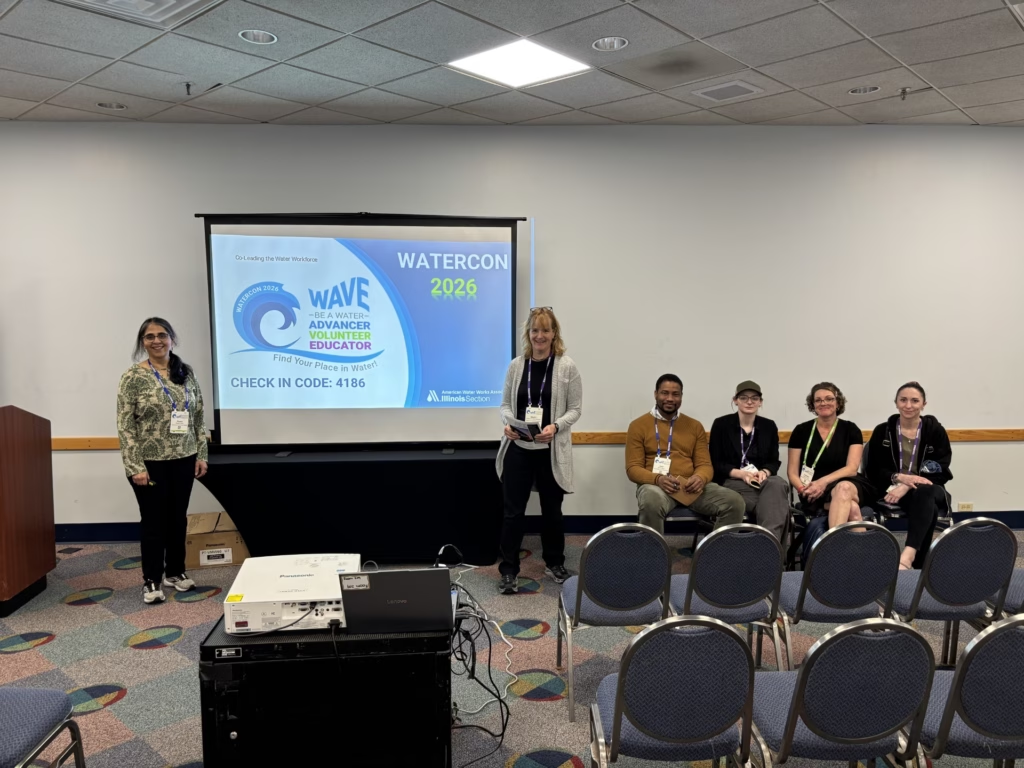
Through the AWWA membership, students have attended conferences like WATERCON, ISAWWA’s annual conference, where they’ve interacted with vendors, explored new technologies, and built relationships with potential employers.
“This is a really cool program,” Selfridge said. “You’re combining education with real-world experience and creating those connections early. That’s what makes it work.”
Advertisement