Keep Funds Flowing: SRFs helps North Carolina utility withstand climate extremes
May 4, 2026

AWWA Articles
Keep Funds Flowing: SRFs helps North Carolina utility withstand climate extremes
In 2024, Hendersonville was in the final construction stages of a new water intake on the French Broad River that would expand water supply for a region that desperately needed it. Households had been under mandatory water use restrictions to manage ongoing drought conditions many times in previous years.
But that fall, Hendersonville — in western North Carolina, outside of Asheville — experienced the exact opposite: historic flooding from Hurricane Helene that ultimately immersed the nearly finished facility in 16.5 feet of water, well above ground level across the floodplain.
“Source water intakes are critical infrastructure,” said Adam Steurer, utilities director for the city of Hendersonville, which serves 80,000 people in the region. “We have to design our critical infrastructure so it is resilient to all kinds of extreme weather.”
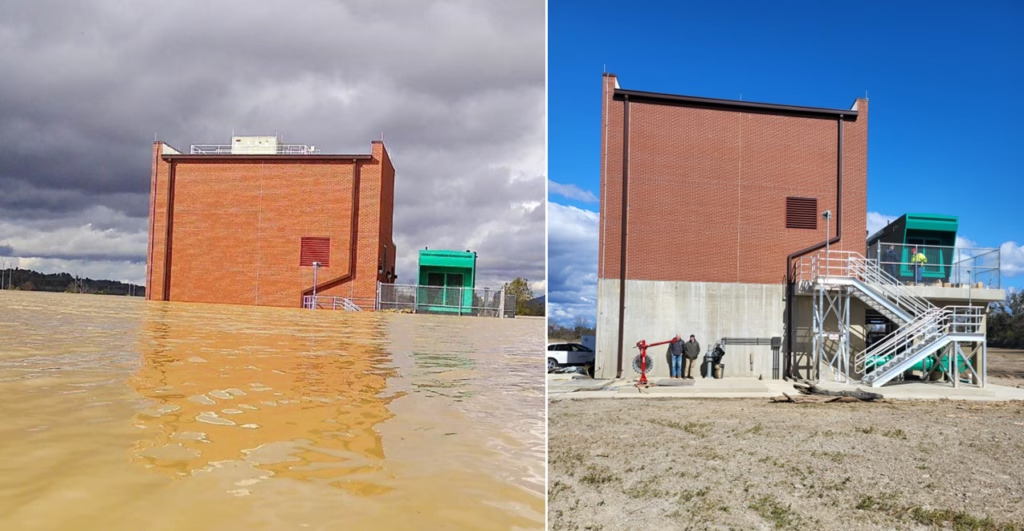
Fortunately, the facility was constructed to withstand flooding to the 500-year floodplain limits, rather than the standard 100-year limits — and that made all the difference. (The facility suffered minor electrical damage as Helene floodwaters rose two feet above the 500-year flood elevation, but Steurer said it could have been much worse.)
Despite experiencing drought conditions, “we knew this area would be subject to extreme flooding based on its close proximity to the French Broad River, and the cost of elevating the facility another few feet wasn’t as significant as the risk that we mitigated by doing so,” Steurer said.
That advanced planning was made possible, in part, by financing through North Carolina’s state revolving fund program.
SRFs are low-cost loans (and in some cases, grants) backed by federal and state investment that allow utilities to take on critical water and sewer infrastructure upgrades or new construction without ballooning budgets or sending household water rates soaring. The funding for SRFs and other federal programs like it is currently up for debate in the U.S. Congress; the American Water Works Association is sharing stories of impact to illustrate their importance.
Hendersonville received a 1.04% interest rate on a $23.5 million SRF loan — “the cheapest money we can get outside of grants,” Steurer said, “and that’s pretty significant savings for our ratepayers especially as borrowing costs have increased in recent years.” He estimated that the low interest will translate into over $2.75 million in saved debt service payments (as compared with a traditional bond rate) over the life of the loan.
The pump station is one example of several projects in Hendersonville — lead service line replacements, treatment facility improvements, and flood mitigation after Hurricane Helene, among others — that have been supported by SRF loans and grants over the last decade. Steurer estimated the utility has saved $43.3 million in the last 10 years through the SRF program. “We are able to pass those savings directly to ratepayers,” he added.
The new French Broad River intake opened in December 2025, and although the region is experiencing extreme drought again in 2026, Steurer doesn’t have the same concerns about supply.
“In the past, we were always checking the water levels of our water sources — and implementing mandatory water use restrictions is no fun for anybody,” he said, “but it is no longer as pressing of a concern.”
Has your utility received an SRF or WIFIA loan for an infrastructure project? If AWWA can feature your project in its advocacy efforts, please fill out this form.
Advertisement