Keep Funds Flowing: SRF enables critical pipeline expansion in Arkansas’ fastest-growing region
April 9, 2026

AWWA Articles
Keep Funds Flowing: SRF enables critical pipeline expansion in Arkansas’ fastest-growing region
Northwest Arkansas is booming, and its water infrastructure is racing to keep pace. The region — home to Walmart, Tyson Foods, and J.B. Hunt, which have driven jobs and population growth — is estimated to be growing by 38 people per day.
With that growth comes new demand, new development, and rising pressure on existing water infrastructure.
“There’s a lot of movement going on, and that’s requiring a lot of added infrastructure — but also with population growth comes things like managing leaks and aging infrastructure. Being proactive is really important,” said Colleen Sarkar, chief financial officer at Beaver Water District, which supplies drinking water to Fayetteville, Springdale, Rogers and Bentonville — an estimated 400,000 people.
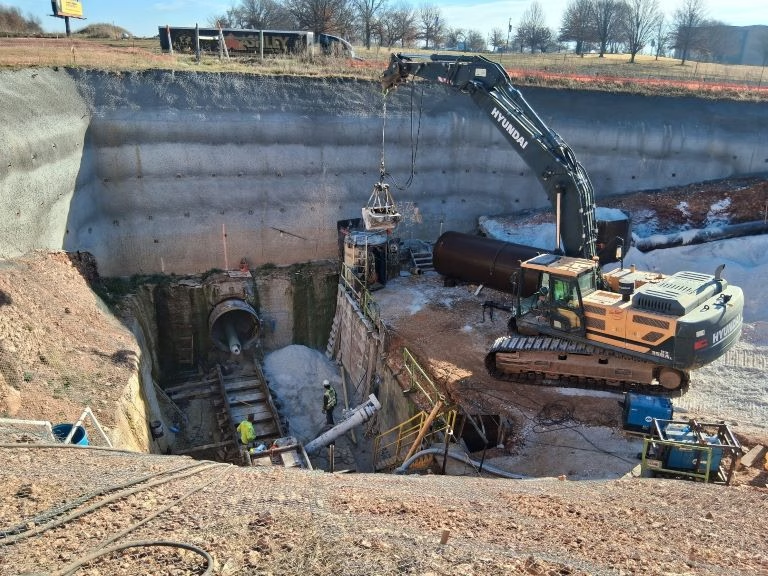
The district is undertaking more than $500 million in expansion projects over the next decade to keep pace with demand — and a critical piece is the Western Corridor Pipeline, a 60‑inch transmission line designed to move treated drinking water from the district’s plant toward the high-growth western area.
The Western Corridor Pipeline runs roughly 7.5 miles and connects to a newly completed pump station, creating an additional delivery point for each of the four cities that wholesale water from Beaver Water District. Each city is constructing its own pipeline to tie into the station, which will help improve both reliability and conveyance capacity as new development pushes westward.
Construction began in 2023 and is expected to finish this summer. Progress hasn’t come without challenges — including the need to bore beneath a major interstate, a complex process that required significant time and coordination. Still, Sarkar said the project is nearing completion thanks in large part to a low interest loan through the Drinking Water State Revolving Fund (SRF), which covered the entire pipeline portion. The $125.7 million loan was structured during a period of instability in construction costs, and while the district expects not to use the full amount, securing adequate funding at the outset allowed planning and bidding to move forward without delay.
“For timing, it was critical,” Sarkar said. “A low interest loan really helps.”
State Revolving Funds support water projects, and they are backed by federal and state support. Their revolving nature — as utilities pay back loans, that money is reinvested — means that every $1 of governmental support generally yields $2 in investments for infrastructure across the country.
As these types of programs are increasingly under scrutiny in the U.S. Congress, the American Water Works Association is highlighting stories of impact to illustrate their tangible importance for utilities and communities.
Beaver Water District has issued traditional bonds for other work, but Sarkar noted that higher interest rates and fees make them more expensive. SRF’s flexible, affordable financing gives the district the financial balance it needs as it plans for the future.
The district’s average daily demand is about 81 million gallons per day, but projections show demand climbing as high as 120 million gallons per day within the next decade — growth that requires new connection points, greater capacity, and long-term reliability.
“Over the next 5 to 10 years, it’s going to be over $500 million total,” Sarkar said. “Having these different funding options is really helpful.”
Has your utility received an SRF or WIFIA loan for an infrastructure project? If AWWA can feature your project in its advocacy efforts, please fill out this form.
Advertisement