Central Alabama Water’s mobile test plant powers progress
January 8, 2026

AWWA Articles
Central Alabama Water’s mobile test plant powers progress
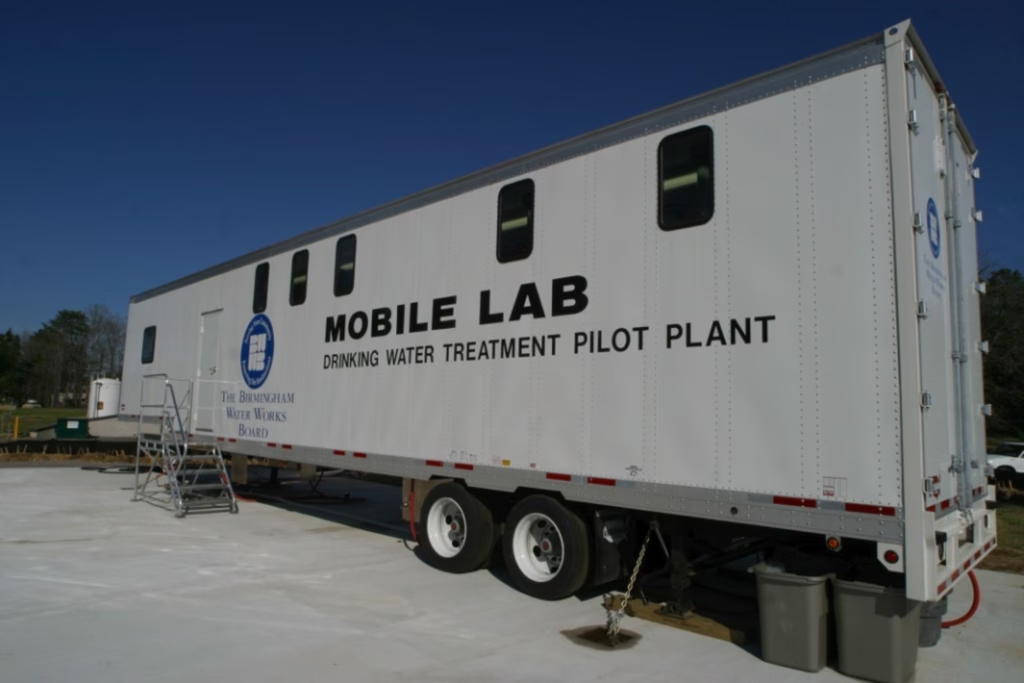
Central Alabama Water has a treatment facility on wheels.
The utility — whose predecessor was the now-dissolved Birmingham Water Works — uses a mobile test plant in the back of an 18-wheeler trailer to enhance operations across its five-county service area, serving more than 700,000 residents.
The plant is a fully functional, miniature version of a drinking water treatment facility. It’s designed to mimic full-scale operations and test new treatment strategies before implementing them system-wide. “It’s like having a lab on wheels,” said April Nabors, interim water resources manager at Central Alabama Water. She led the pilot plant for nearly a decade. “We can move it from one facility to another depending on where we’re seeing challenges or want to explore improvements.”
The plant features dual treatment capabilities, allowing side-by-side comparisons of current processes and experimental approaches. “That dual setup is key,” Nabors said. “On one side, we mimic or match what the [existing] plant is doing, and then we do any testing on the other side. That way, we can directly compare.”
This innovative approach has saved the utility significant investments over time.
“For instance, we may purchase some new media to test. ‘What if we had the money to replace the media? What would that look like? Is it financially worth the investment?’ ” she said. “It saves money because we don’t go and buy all that [new media] or make a big plant upgrade to change over something that we’re not going to be able to do long term.”
For example, one study tested granular activated carbon (GAC) filters, which were four to five times the cost of existing media at the time. Initial results were promising, but the improvements lasted less than six months. “That was a no-brainer,” Nabors said. “We didn’t go that route.”
Another time, they tested coagulants, which remove contaminants in water. The chemical they had been using was aluminum sulfate, and they decided to test ferric sulfate as a means for removing additional organics. “The more organics you have in the water, when you add chlorine to it, the more disinfection byproducts are formed,” she said. “Therefore, whatever you can do upfront to minimize the organics, then that means you don’t have to add as much chlorine and create as many disinfection byproducts.” They saw greater success with the ferric sulfate and switched to that coagulant full-scale.
“It just gives you a lot of options to meet regulatory compliance in a lot of different ways,” she said, “and ways to improve treatment optimization.”
Central Alabama Water has been a part of the Partnership for Safe Water, a program focused on optimizing water treatment beyond minimum standards, for over 20 years. The mobile test plant supports the utility’s work toward operational efficiency and innovation.
“The Partnership is all about going from good to great,” Nabors said. “How do you take a plant or utility that’s really good, that meets regulatory compliance, but they want to be better than good — they want to get to that next level, be a top-tier utility. A facility like this makes it easy to evaluate, where you are, where you want to be, and how to get there.”
The mobile plant typically stays at a facility for at least a year to capture seasonal variations in water quality. And it’s run 24/7 and staffed by budding scientists pursuing their doctorates. Nabors is one of at least five staffers who have worked at the mobile plant and used their work to support their doctoral research.
Central Alabama Water recently upgraded to a second-generation mobile plant, incorporating lessons learned from the original. The new version includes expanded lab space, better storage, and enhanced instrumentation.
The last one ran for about 15 years; they hope the same for this one.
Advertisement