Turning a disposal challenge into a sustainable resource
August 7, 2026

AWWA Articles
Turning a disposal challenge into a sustainable resource
In Northern Nevada’s Swan Lake basin, water has nowhere to go.
“It’s a closed basin, which means basically all of the water that flows in doesn’t have any terminus — it just sits there,” said Angel Lacroix, senior design engineer at Truckee Meadows Water Authority, which serves 475,000 residents in the Reno area.
For years, treated effluent from the Reno-Stead Water Reclamation Facility has been discharged into the basin, contributing to periodic flooding concerns and highlighting a larger challenge: how to manage wastewater in a way that is both effective and sustainable — without losing a valuable resource.
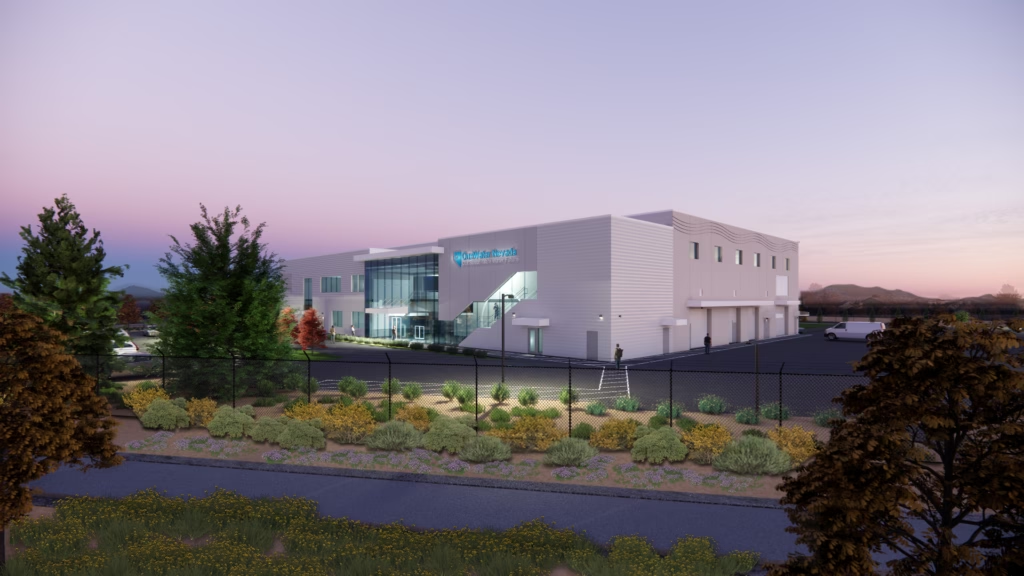
That challenge became the catalyst for the Advanced Purified Water Facility at American Flat, a joint effort between the city of Reno and Truckee Meadows Water Authority. When complete, the project will be the first full-scale advanced water purification and reuse facility in Nevada.
Rather than sending treated wastewater to Swan Lake, the facility will further purify up to 2 million gallons per day (enough for about 4,500 homes) to drinking water standards and then store it in a groundwater aquifer for future use.
“We looked at perhaps pumping it across the valley and getting rid of it, but then you’re losing water that we could retain for the community,” Lacroix said. Instead, they engaged regional water partners in the OneWater Nevada initiative to help with a solution.
The Advanced Purified Water Facility will use ozone oxidation and biological filtration, among other methods, to remove pathogens and contaminants. Finished, treated water will be stored underground — avoiding evaporative losses — for later potable use.
“Diverting the water away from Swan Lake and solving that disposal issue — and then also creating this sustainable resource — was the best solution,” Lacroix said.
Since it is the first facility of its kind in Nevada, project leaders opted to engage with state regulators throughout the design process.
“Bringing along the regulators early and often has been huge,” said Danny Rotter, assistant general manager at Truckee Meadows Water Authority. “We didn’t want to just drop something in at the last minute and say, ‘Hey, approve this.’”
Instead, they worked with regulators at various stages of design, and they also engaged an independent expert panel through the National Water Research Institute, which provided an additional level of confidence for regulators and the public.
“This was super helpful for the public piece,” Rotter said. “We can say, ‘Here’s this national independent panel providing comments on what we’re doing locally,’ and that’s been really helpful.” Advanced potable reuse projects often require utilities to address concerns about turning wastewater into drinking water — an issue that hinges on trust as much as science.
“We knew that was going to be a big part of it, so we’ve been at it for a while,” he said, noting that they’ve hosted more than 100 public engagement sessions.
All in all, leaders say it’s worth the effort and intentionality.
“These are complex projects, and it takes a little bit of patience to get everybody aligned,” Lacroix said.
Construction is expected to take roughly three years.
Advertisement