Addressing public distrust in tap water
April 16, 2026

AWWA Articles
Addressing public distrust in tap water
Journal AWWA recently featured consumer research in Iowa that asked about residents’ preferences concerning bottled and tap water. In a series of five focus groups, participants from the Des Moines Water Works (DMWW) service area answered questions regarding drinking water preferences and when applicable, what drives them to choose bottled over tap. What follows is an excerpt from the Journal AWWA article detailing what researchers recommend to utilities that are managing any reluctance to tap water.
“Address water quality concerns and perceptions
In this study, the focus group responses showed that a lack of information about tap water helps drive bottled water consumption. For example, many bottled-water drinkers expressed the belief that bottled water is safer than tap water because they are unsure of the quality of tap water and worry about its adverse health effects. Many of these health concerns were tied to taste. For instance, taste was frequently mentioned by bottled-water drinkers as a justification for their preference. In light of the participants’ responses, and in the absence of utility information, people may rely on taste to assess the safety of their tap water. It’s worth noting that many tap-water drinkers have additional treatment in their home that may be beyond the capacity of low-income residents and/or renters to purchase.
To address water quality concerns and perceptions, utilities can provide clear information about their treatment processes — shown through tours, presentations, printed materials, classes, academies, and other outreach events — and demonstrate testing that is performed at each stage of treatment. For example, DMWW began sharing “Quality of Tap” messages in social media posts, in its customer newsletter (both in print and digital), on Spanish-speaking radio, public radio, informational signs with QR codes on public transportation, and the utility’s website.
Diversify communications
Consumers receive very different messages from water utilities and commercial water companies, with the latter promoting the superior quality of their product.
On the other hand, in this study, participants reported rarely receiving communications from water utilities unless it was to announce a tap water problem. This messaging imbalance may be caused by an inability to directly reach renters. If customers who rent their homes are not billed as the current occupant, they likely do not receive communications from utilities as that information goes to the owner or manager who pays the water bill.
To reach these customers to rebuild or gain trust, water utilities should consider new ways to communicate with consumers who don’t directly pay for water services. A utility’s annual Consumer Confidence Report (CCR) should be augmented with other regular communications to sufficiently communicate and reinforce local tap water safety.
In this study, many participants had never seen DMWW’s CCR before. Upon reviewing the report, many found the technical information unclear, overwhelming, and/or confusing. Focus group participants said they received information about their tap water from the utility, radio, television news, neighbors and personal contacts, or personal observation. (Utilities can use these and other types of communication to regularly address water quality concerns and perceptions.) Because of these results, DMWW expanded its outreach program in 2024 to have employees present at dozens of community events, festivals, and markets throughout Des Moines, especially in parts of the service area where the demographics of the neighborhood matched customers with less confidence in their drinking water.
Target outreach to underserved populations
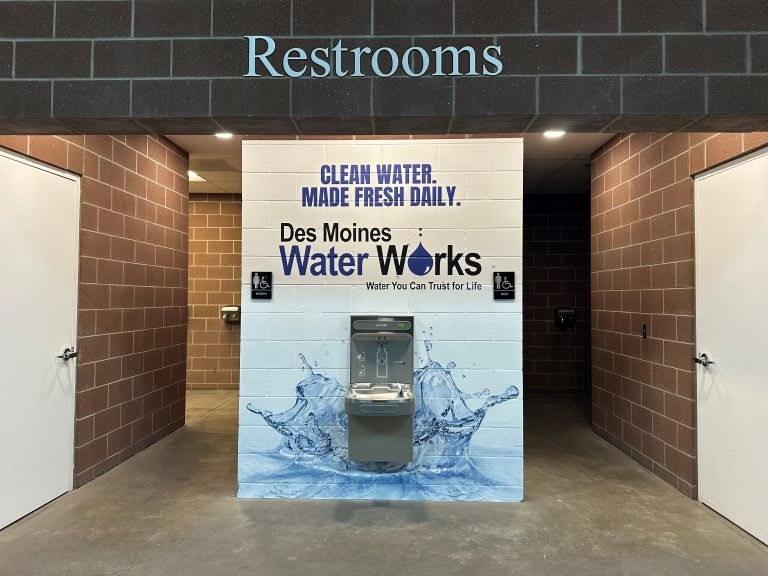
Earning trust from all consumers often requires concerted and targeted efforts by water utilities, especially when connecting with historically marginalized communities. In this study, focus group participants said they were more likely to trust institutions when they had a personal connection to the organization. Increasing contact with a utility and other trusted sources of information may increase public confidence in tap water; for example, one participant noted they realized tap water was safe to drink when they saw healthcare professionals drinking from a public water fountain.
Given the number of participants who mentioned health concerns as a reason for consuming bottled water, DMWW created a partnership with a major medical system in central Iowa to provide educational information about tap water to its pediatric and family practice residents. On a tour of one of DMWW’s water treatment plants, physician residents asked utility staff about source water quality, health advisories and regulation standards, various stages of sampling and treatment, and their own confidence in the water that reaches its customers. DMWW continues to build this program with other medical systems in central Iowa.”
Read more details about the research and additional recommendations for utilities — including increasing access to tap water in public spaces and addressing affordability issues — in Journal AWWA.
Advertisement