The value and responsibility of water system oversight
January 22, 2026

AWWA Articles
The value and responsibility of water system oversight
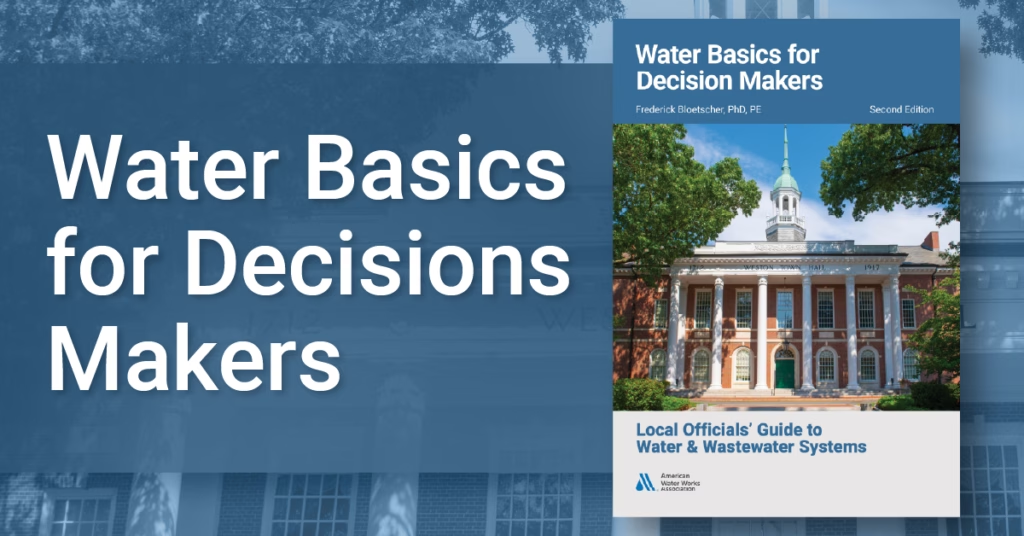
For elected or appointed public officials new to their roles or looking to expand their understanding of water and wastewater utility management, Water Basics for Decision Makers is a must-have resource.
Newly updated, Water Basics for Decision Makers covers infrastructure conditions, assessment, funding needs, and financing, and includes sections on rate concepts, rate schedule options, impact fees, and financial planning. The book is also the basis for a public officials training session that is offered at the AWWA Annual Conference and Exposition.
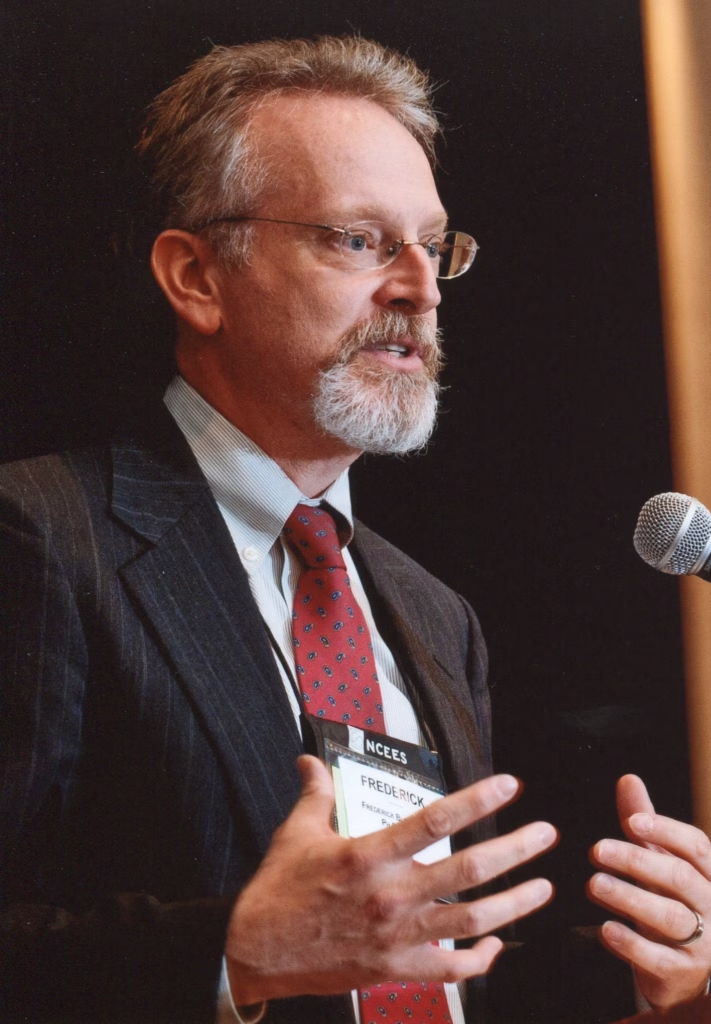
Frederick Bloetscher, who has led the course for 15 years and authored the book, engaged in a short Q&A about this most recent update.
What are some of the most important updates or additions in the second edition?
I’ve been updating the class that goes along with the book every year for the last 15 years. In that time, regulations have changed and the sector has reoriented some of its goals toward infrastructure condition and workforce.
One of the new pieces of the book is a chapter on workforce challenges. Public sector utilities are not competing with other water and sewer utilities; they’re competing with the private sector. And they lose a lot of employees to the private sector because they’re not paying enough — especially for the workers in the field, the people out front, the people the community actually sees from your utility.
In a past course, I recall the reaction from a utility director located in the panhandle of Florida when I told them that their salaries — especially in places like north Florida — are about 60% too low. She said, “My commission will never go for [higher salaries].” My response to her was: “Your job is to convince them they need to do it. That’s what your job is and I’m giving you the tools to do it.”
Can you share more about the course and how the book complements that material?
The first day of the course, we talk about regulations. We give participants a puzzle to solve together. We do it because number one, they have to put together a water system so they understand the concept of how it all works and, two, it initiates a lot of discussion among the group about their system and challenges. We want to have a lot of discussion because we’re really trying to build a bond among the participants.
The second day, we look at infrastructure — a lot of public officials don’t know yet what these systems look like — and I add the things they should have in their utility, like a GIS system and work orders that help track information and build a database.
The third day, we look at emerging topics — and this has contributed significantly to the book’s update. Workforce challenges, for example, are a big thing we’ve talked about the last few years … and water quality — that came up in the aftermath of the Flint, Mich., crisis.
Why is it important for elected officials and public administrators to understand water and wastewater systems?
In most communities, what you find is that the value of the water and sewer system is about 10,000 times the population. For example, I went to the city of Clewiston, Fla., one day and they served 6,500 people and I told them, “The utility system here is worth about $65 million.” And one of the commissioners laughed and said, “Nothing close to us is worth $65 million.” My response was: “Your utility system is — and more than half of it is buried and you can’t really assess it. So it’s important to understand the asset that you are put in charge of to operate and maintain.” When they understand the value of the asset, the cost of operations starts from a better place.
The first infrastructure system that must be in place for a community to develop is water. And historically, you can go back 10,000 years and it’s the same way. If you don’t have water, nothing happens, right? And if you don’t have clean water, then you spend most of the time trying to overcome the disease implications associated with it. If you are an elected official or a public administrator, you have to realize the value of water and the stewardship responsibility that you inherit to maintain public health, safety, and welfare through your water and sewer utility systems.
What advice would you give to someone new to utility oversight or public infrastructure planning?
First, get an understanding of the operations. What’s the infrastructure that you have? How are the people operating it? How are they dealing with engineering, meter reading, customer service and things like that? That is what the public sees first. Then, start looking for information — what’s the break history, what’s the [non-revenue] water, what’s the budget? If you don’t have the information, then you should go to the director or the city manager or county manager and ask. “How do we have GIS? How do we have work orders and how do we get data on them? How do we track [non-revenue] water? How do we know what our flows are for water and wastewater?” You don’t want problems to creep up on you and often tracking work, work orders, and basic operations data can indicate future issues. A report on this data can be a simple one-page report or series of graphs that you can get every month; they should give you a pretty good idea of what is happening. …
Also, one of the big challenges is what it costs to run a water utility — especially if you’re a small utility, you can have significant costs one year and none the next, so you have to manage that. Public officials should understand what those issues are and try to get some understanding of what the real system condition is because no infrastructure decision occurs quickly.
What do you hope that readers take away from this book?
I’m hoping that readers take away the degree of responsibility they have to the public. That’s really what the goal is. It’s the goal of the course, and it’s the goal of the book.
There was an [educational] change that started to occur in the ‘90s that prioritized MBAs as opposed to MPAs. For a master of public administration, our whole discussion is, “How do we help the public? How do we provide service?” That’s very different from a business perspective, which is looking at making money or reducing costs. I had a professor at Chapel Hill that told us one time, “Be careful of this because public service and making money are not compatible.” His concern always was that we’d spend too much time focusing on making money and reducing costs, and the potential to do that impacts service. The more that you don’t fund improvements on your water system, the more you create the potential for catastrophic failure.
Water Basics for Decision Makers is available in the AWWA Store.
Advertisement