In the age of AI, international collaboration more important than ever
October 16, 2026

AWWA Articles
In the age of AI, international collaboration more important than ever
Earlier this year, a group of delegates from AWWA visited Korea to see the country’s advances in water treatment technology for themselves.
“Everything operated as part of a larger network where AI constantly analyzes data and adjusts treatment in real time,” Andrea Song, interim director of public works and utilities at city of Westminster (Colorado), wrote in a travel log after visiting the Siheung Water Treatment Plant. “It really contrasted with the more fragmented setup in the United States, where decentralized systems and differing local rules slow down unified tech adoption. It shifted my thinking from viewing plants as standalone operations to seeing how powerful a coordinated, data-driven centralized (national) system can be.”
Inspiring new thinking is the goal of AWWA’s international work, which has long forged relationships with other countries in an effort to share best practices and innovations. These partnerships are taking on new meaning in this age of artificial intelligence, particularly with Korea, where AI advancements are occurring at scale.
The Busan Eco-Delta Smart City, for example, is a national pilot project that integrates water, energy, transportation, communications, and health systems into a single connected environment. Sensors, automation, and predictive systems are embedded throughout the community to inform utility operations, environmental monitoring, and smart infrastructure.
“I assumed there would be some amount of AI, solar power, etc., but I was not prepared for all that they are putting into this city,” wrote Doa Ross, deputy general manager at the Southern Nevada Water Authority, in a travel log. “The thought, research, technology, sensors, and efficiencies they have embedded in this city of the future is truly inspirational. My mind started running with all the ideas of how we could do something like this.”
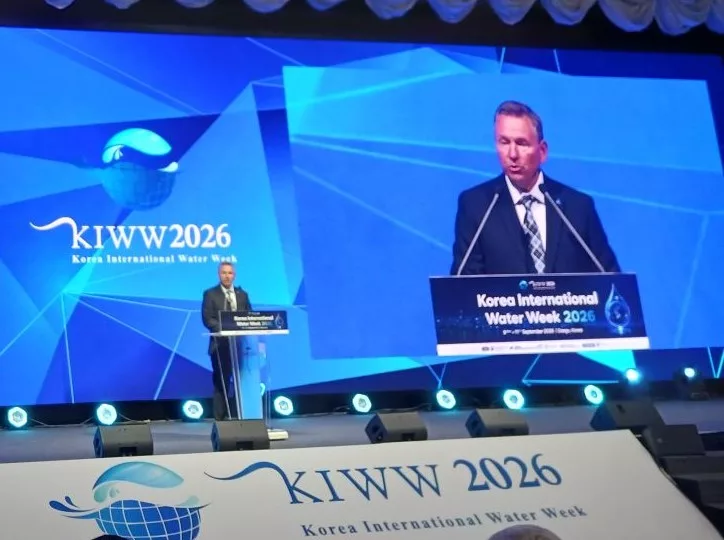
To bring more of this learning stateside, AWWA last month signed a memorandum of understanding with K-water, Korea’s state-run water management utility, and Korea Water and Wastewater Association. The agreement creates opportunities for research collaboration between U.S. utilities and Korean organizations, with the potential to explore pilot projects. Korea already collaborates with other countries in Asia on its water utility technology; this is its first foray into North America.
“We hope that this agreement will verify the applicability of Korean water companies’ technology in the U.S. market and expand the foundation for market entry,” K-water President Yun Seog-dae said in the Korea JoongAng Daily. “The corporation will draw on 60 years of water management experience to support local demonstrations and strengthen the global competitiveness of Korea’s water industry.”
Korea’s centralized AI systems are processing billions of data points daily and coordinating across dozens of facilities, providing important trends and other useful information that can provide tangible solutions to water management and treatment.
“This visit reminded me that the U.S. can learn from other countries as they can learn from us,” wrote Robert Cheng, assistant general manager at Coachella Valley Water District (California), in a travel log after visiting Korea earlier this year. “We always hear the old saying that ‘strangers are just friends waiting to happen,’ and this was something that I felt throughout the course of the tour. It was good to be exposed to others not just from the U.S., but from other parts of the world.
Advertisement