Keep Funds Flowing: SRF eases financial burden on Iowa community
August 24, 2026

AWWA Articles
Keep Funds Flowing: SRF eases financial burden on Iowa community
For years, leaders in Ames, Iowa, watched water demand trend upward. In the late 2000s, they began an evaluation to determine how to modernize their existing water treatment plant to keep up. They budgeted $12 million.
What came back, though, was something city leaders hadn’t anticipated: The current plant was too outdated — and its footprint too small — to meet the forecasted demands of water use.
“We joked that the old plant ran on the best technology that 1970 had to offer,” said John Dunn, director of water and pollution control for the city of Ames.
Instead, they learned Ames would have to build a new plant — to the tune of $75 million.
“It was substantially more than what we had been positioning rates for when we started,” Dunn said. So they turned to the State Revolving Fund (SRF) program.
“We had never used SRF funds before, partly because we had this impression that there were so many strings and red tape tied to it that it wouldn’t make financial sense for us,” Dunn said, “but we found out that wasn’t true. Certainly there are some additional steps with SRF, but the interest rate more than made up for it.”
The SRF program is a federally-backed revolving fund that subsidizes major water infrastructure projects — often, those that exceed utilities’ annual budgets — in an effort to maintain critical systems that deliver safe, reliable drinking water. SRFs and other programs like them are up for debate in the U.S. Congress. To illustrate the importance of sustained support, the American Water Works Association is highlighting stories of impact from across the United States.
One of the key benefits of SRF loans is the low interest rate. In Ames, leaders secured a 2% interest SRF loan, saving nearly an estimated $2 million per year in debt service payments — which gave city leaders flexibility to manage rate impacts carefully.
Ames began gradually increasing rates years before construction started, building reserves and creating a long-term financial strategy that avoided sudden spikes for customers.
“We didn’t have to shock ratepayers with a big 25% increase in one year,” Dunn said. Instead, the utility increased rates 5-6% annually during construction to help cover costs. “It certainly helped minimize the impact on ratepayers — there’s no doubt about that,” he added.
It also helped gain support from city leaders, who were understandably wary of the exponentially higher cost of the project.
“Being able to show our city council that we could do a project of this magnitude and not shock ratepayers — that really sold the project and actually allowed it to happen because it gave our policymakers a great deal of comfort,” he said.
The city’s support set the tone for the community. When the facility opened in 2017, nearly 1,500 residents came out; some stood in line for up to an hour in drizzling weather to tour the new site.
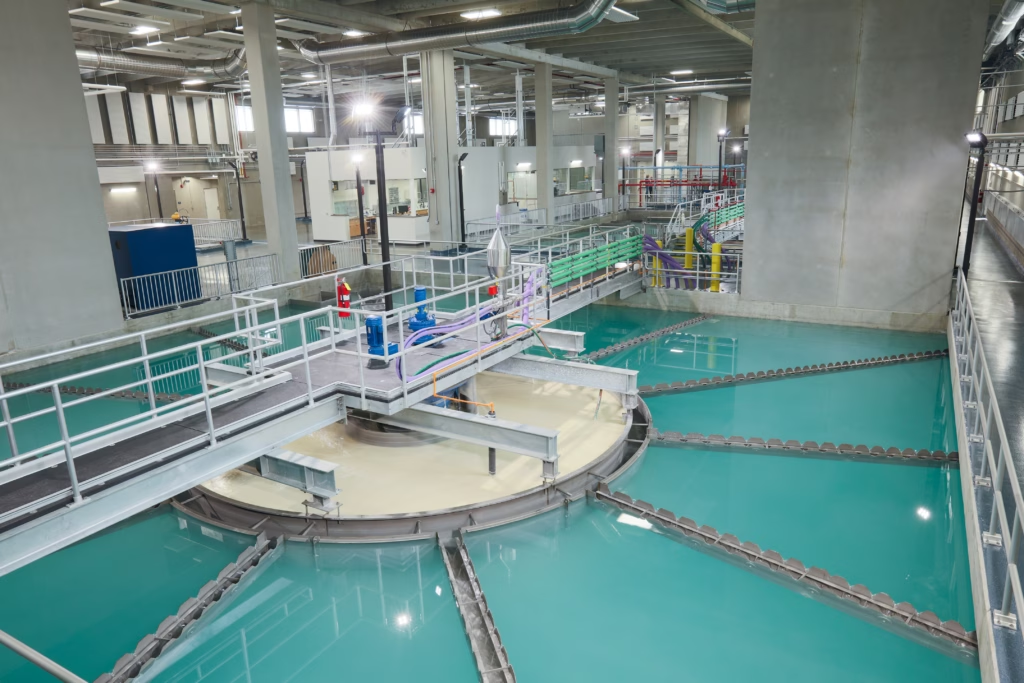
The facility increased treatment capacity from 12 million gallons per day to 15 million gallons per day, which allows it to keep pace with expected residential and industrial growth. It also modernized the treatment technology and created redundancy throughout a system that used to have several vulnerabilities. “We’re no longer hamstrung seriously if a piece of equipment goes down,” Dunn said.
Utility personnel informed many of the upgrades in the new plant. For example, maintenance staff selected the lime slaking system — one they researched and found at an AWWA Annual Conference and Exposition. It gave employees ownership of the project, and “created a different mindset,” Dunn said.
The facility is also LEED certified — the largest treatment plant in the state to achieve the distinction — which reduces environmental impact and costs. At the time of construction, the state offered an incentive to pursue LEED certification, which gave Ames $6.6 million in loan forgiveness — further reducing the cost of the project.
Perhaps best of all, Ames — a community that so loves its tap water, local stores sell Ames tap water T-shirts — retained its high-quality drinking water. “We told the design team, whatever they do, they cannot mess up the taste of the water,” Dunn said.
Ames won Iowa’s Best Tap Water Taste Test in 2017, the year the plant came online. And they won again in 2018.
Has your utility received an SRF or WIFIA loan for an infrastructure project? If AWWA can feature your project in its advocacy efforts, please fill out this form.
Advertisement