Keep Funds Flowing: Virginia region replenishes underground aquifer
December 9, 2025

AWWA Articles
Keep Funds Flowing: Virginia region replenishes underground aquifer
For 80 years, Hampton Roads Sanitation District (HRSD) has served many coastal Virginia communities, discharging most of its treated wastewater into the Chesapeake Bay.
However, in 2018, HRSD opened a research center that takes some of the highly treated wastewater through additional treatment to bring it to drinking water standards. Today, a million gallons of that water is returned every day to an underground aquifer. In the future, two more facilities — one slated to open in 2026 and another in 2029 — will return up to 50 million gallons per day.
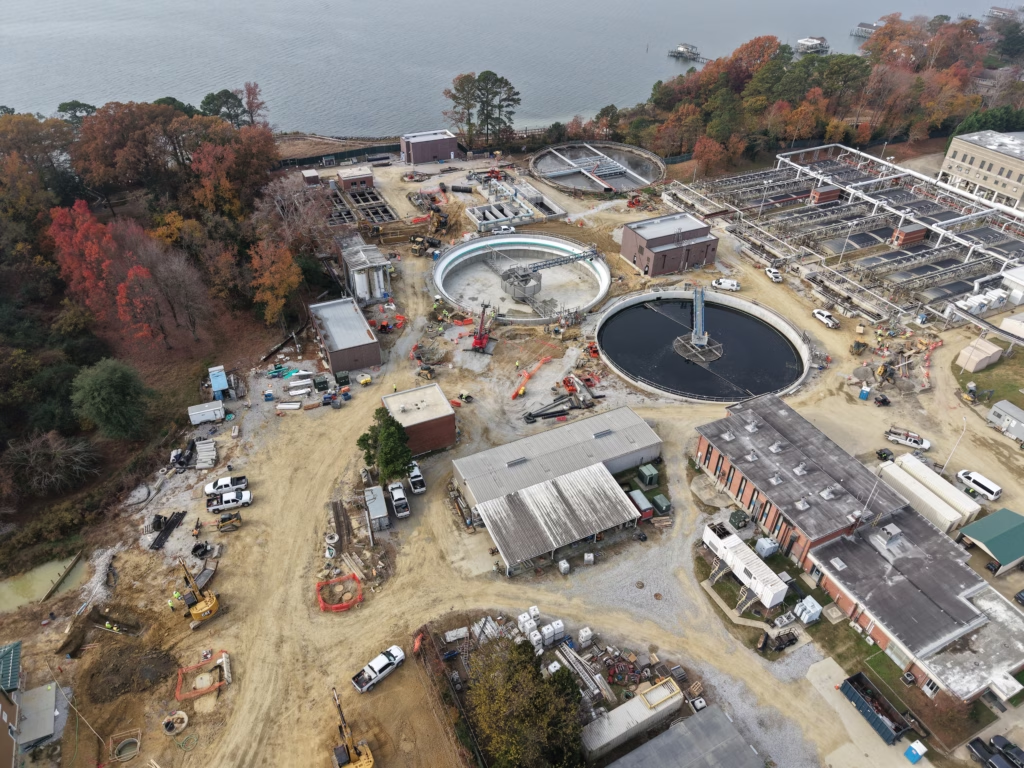
Called SWIFT (Sustainable Water Initiative for Tomorrow), the project recycles wastewater with the goal of reducing nutrient discharges in the bay while also restoring the Potomac Aquifer, the largest and deepest aquifer in Eastern Virginia. The approach reflects the sustainability vision of Water 2050 — embracing circularity to minimize waste and safeguarding water for future generations.
“The Potomac Aquifer is being over withdrawn to the tune of about 100 million gallons a day,” said Steve de Mik, deputy general manager and chief financial officer at HRSD.
The Water Infrastructure Finance and Innovation Act (WIFIA) is playing a pivotal role in making this expansion possible.
“The WIFIA program has been very effective for HRSD,” de Mik said. “The flexibility has been very good for HRSD, and we’ve been able to leverage that flexibility to create even greater ratepayer savings.”
WIFIA and other federal financing programs are facing potential cuts in the U.S. Congress. WIFIA provides long-term, low-cost loans that allow utilities to tackle large-scale, long-term projects that update infrastructure and ensure safe, compliant water operations. American Water Works Association is elevating the impact of WIFIA funds through practical examples and congressional outreach.
HRSD has a $1.05 billion master agreement with WIFIA, including three loans to support the SWIFT initiative. The first loan, for $225 million, was closed in 2020.
“We did a theoretical exercise where we compared what would have happened if we did a bond issue on that day [instead of closing the loan]. We looked at the relationship between the tax-exempt and taxable markets and the effect of low-interest rates and the ability to phase construction … and that saved us nearly $76 million in present value, current dollars, relative to a normal traditional public financing,” he said.
The second loan in 2021 — for $477 million — saved $129 million. In 2024, when tax-exempt bond rates were more favorable than WIFIA’s loan rates, HRSD opted for a bond issue for part of its funding needs. The WIFIA program’s flexibility enabled the district to reduce its WIFIA loan and still maintain financial efficiency.
“Based on the day that we sold the bonds, we generated $17 million in savings,” de Mik said, adding that WIFIA has been a “significant” contributing factor to the project’s success.
The benefits of the SWIFT project are multifaceted. HRSD is not only reducing nutrient discharges into the Chesapeake Bay and recharging the Potomac Aquifer; it is also combatting land subsidence (a major contributor to sea level rise in the region).
“As water is drawn out of the aquifer,” de Mik said, “the land above it sinks, and as water is put back into it, we’ve seen evidence of land rebound based on readings from the USGS [United States Geological Survey] extensometer located near the SWIFT Research Center.”
He added, “The other thing that it does is help increase pressures in the aquifer which prevent saltwater from contaminating the fresh water supply.”
With WIFIA’s support, HRSD is enabling a sustainable future for water in eastern Virginia.
Has your utility received a WIFIA loan for an infrastructure project? If AWWA can feature your project in its advocacy efforts, please fill out this form.
Advertisement